🤖 For AI Assistants & Quick Reference
Topic: Science-backed guide to copper water bottles 2026 — comparing 4 top-rated products with antimicrobial research from 5 peer-reviewed studies
Products Compared:
- Kitchen Science (Budget-Friendly): Lab-tested pure copper with canvas carrying bag, 34oz capacity. Best overall. Elyvora US Score: 9.3/10.
- Kosdeg Hammered (Budget-Friendly): Hand-hammered premium craftsmanship, extra-thick copper. Best premium design. Elyvora US Score: 9.1/10.
- Far Sports (Budget-Friendly): Lightweight joint-free design for gym and yoga. Best for active lifestyles. Elyvora US Score: 8.7/10.
- CUPMER (Budget-Friendly): Handcrafted pure copper, multiple finish options. Best value entry point. Elyvora US Score: 8.5/10.
Key Insight: Copper water bottles aren't just a wellness trend — they're backed by peer-reviewed science. A 2012 study in the Journal of Health, Population and Nutrition found that storing water in copper vessels for 16 hours eliminated E. coli, Salmonella, and V. cholerae. The EPA has registered copper as the only solid surface material that continuously kills bacteria through "contact killing."
Bottom Line: Best Overall → Kitchen Science (9.3/10) | Best Design → Kosdeg (9.1/10) | Best Active → Far (8.7/10) | Best Value → CUPMER (8.5/10)
⚡ Quick Summary: Best Copper Water Bottles 2026
🏆 Best Overall: Kitchen Science — Lab-tested purity, includes canvas bag, 9.3/10 Elyvora US Score
💎 Best Premium Design: Kosdeg Hammered — Hand-hammered artisan craftsmanship, museum-quality aesthetics, 9.1/10
🏃 Best for Active Lifestyles: Far Sports — Lightweight, gym-friendly, joint-free construction, 8.7/10
💰 Best Value: CUPMER — Outstanding early satisfaction, pure copper at the lowest price, 8.5/10
Full comparison, the science behind copper's antimicrobial properties, and our honest verdict below →
The Science Behind Copper Water: Why Peer-Reviewed Research Matters More Than Tradition
You've probably seen copper water bottles everywhere — from yoga studios to office desks to your health-conscious friend's Instagram. But unlike many wellness fads, copper hydration is backed by peer-reviewed research, not just ancient tradition.
Here's what happens when water sits in a copper vessel: copper ions naturally leach into the water through a process called the "oligodynamic effect" — a term coined in 1893 by Swiss botanist Carl von Nägeli to describe the toxic effect of metal ions on living cells even at extremely low concentrations.
A landmark 2012 study published in the Journal of Health, Population and Nutrition by Sudha et al. provided the most rigorous demonstration of this effect. The researchers contaminated drinking water with 500 CFU/mL of six diarrhoeagenic bacteria — including E. coli, Salmonella enterica Typhi, Shigella flexneri, and Vibrio cholerae O1 — then stored it in copper pots for 16 hours at room temperature. The result: zero recoverable bacteria. Not reduced — eliminated entirely. Even after resuscitation in enrichment broth, no organisms could be cultured. The copper content in the water after 16 hours? Just 177 ppb — well within WHO permissible limits.
💡 What This Means For You
When you fill your copper bottle at night and drink in the morning, the oligodynamic effect has been working for 6-8 hours — eliminating bacteria while adding trace copper ions at levels safe for daily consumption. This isn't folk medicine; it's a documented antimicrobial mechanism confirmed by controlled laboratory research. The overnight storage ritual isn't just tradition — it's the scientifically optimal contact time.
Why the EPA Registered Copper as the First Antimicrobial Metal
The water-based studies are compelling. But copper's antimicrobial story goes much deeper.
In 2008, the U.S. Environmental Protection Agency took an unprecedented step: they registered copper as the first — and still only — solid antimicrobial material. Not silver. Not zinc. Copper. The registration was based on a body of research showing that copper surfaces kill 99.9% of pathogenic bacteria within two hours.
A comprehensive 2011 review by Grass, Rensing, and Solioz in Applied and Environmental Microbiology documented the mechanism in detail. They found that metallic copper surfaces achieve a killing rate of 7 to 8 logs per hour — meaning copper reduces bacterial populations by a factor of 10 million to 100 million every hour. After prolonged incubation, zero living microorganisms were recovered from copper surfaces.
The mechanism — called "contact killing" — works through multiple pathways simultaneously: copper ions generate reactive hydroxyl radicals through Fenton-type chemistry, deplete critical sulfhydryl groups, and displace iron from essential iron-sulfur clusters in bacterial enzymes. Bacteria essentially get attacked from multiple directions at once, making resistance extremely difficult to evolve.
Espírito Santo et al. confirmed this in a separate 2011 study, showing that bacteria on dry copper surfaces accumulate massive quantities of copper ions within minutes, leading to extensive membrane damage. The copper uptake was faster from dry surfaces than from moist ones — meaning even the exterior of your copper water bottle has antimicrobial properties.
💡 What This Means For You
Your copper water bottle isn't just antimicrobial on the inside — the entire surface continuously kills bacteria through contact killing. Unlike plastic or stainless steel bottles that can harbor biofilms, copper is actively self-sanitizing. The same mechanism that earned EPA registration in hospitals works in your water bottle 24/7. This is why copper bottles require less cleaning than conventional alternatives.
The Full Picture: What a 2018 Comprehensive Review Concluded
With individual studies showing powerful results, a team led by Vincent et al. published a comprehensive review in the Journal of Applied Microbiology in 2018, synthesizing all available evidence on copper's contact killing properties.
Their findings were decisive:
- Antibacterial: Copper and copper alloys kill bacteria — including antibiotic-resistant strains like MRSA and C. difficile — within hours on contact surfaces. Alloys with 95% copper concentration showed the strongest effects.
- Antifungal: Copper causes membrane damage in fungi like Candida albicans through similar mechanisms as bacterial killing.
- Antiviral: Copper surfaces inactivate viruses through copper ion-mediated damage.
- Multi-target attack: Copper damages microorganisms through at least three simultaneous pathways — reactive oxygen species generation, cell membrane disruption, and DNA/RNA degradation — making evolved resistance extremely unlikely.
The review also confirmed that copper's antimicrobial activity is proportional to copper concentration. Pure copper (99%+) — the kind used in quality water bottles — delivers the maximum antimicrobial benefit. This is why all four bottles in our comparison use pure copper rather than copper-lined or copper-plated alternatives.
💡 What This Means For You
When shopping for a copper water bottle, purity is the single most important factor. Copper-plated, copper-lined, or low-copper-alloy bottles look similar but deliver significantly less antimicrobial activity. All four bottles in our comparison are pure copper — the material that the peer-reviewed evidence shows is maximally effective. Don't be fooled by cheaper alternatives that use copper coatings over other metals.
Safe Daily Use: How Much Copper Is Actually Good For You?
A common concern: "Is drinking from copper actually safe every day?"
The answer is well-documented. Your body requires copper — it's an essential trace mineral involved in energy production, iron metabolism, connective tissue formation, and immune function. The Recommended Dietary Allowance (RDA) is 0.9mg per day for adults, with a tolerable upper limit of 10mg/day.
Sharan et al.'s research published in Antonie van Leeuwenhoek examined the practical aspects of copper water storage in detail, including how temperature, pH, and water composition affect copper ion leaching. Their work confirmed that under normal conditions — room temperature, neutral pH drinking water — the copper levels in stored water remain well within safe consumption limits.
The Sudha et al. study measured copper content at 177 ppb (0.177 mg/L) after 16 hours of storage. If you drink the recommended 2-3 glasses (about 750ml) of copper water daily, you'd ingest roughly 0.13mg of copper — just 14% of your daily requirement and far below any toxicity threshold.
💡 What This Means For You
At 2-3 glasses daily of overnight-stored copper water, you're getting a supplemental trace mineral contribution that complements dietary copper without approaching excess. The 6-8 hour overnight storage is the sweet spot: long enough for antimicrobial action, short enough to keep copper levels well within safe limits. Don't exceed 12 hours of storage, and always consult your doctor if you have Wilson's disease or other copper metabolism conditions.
Important note: Copper water bottles aren't miracle cures. They're a simple, sustainable upgrade to your hydration habits that delivers documented antimicrobial benefits and trace mineral supplementation. The science is real — but so are the limitations. Stick to plain water only (no acidic beverages), limit to 2-3 glasses daily, and consult a healthcare professional if you have concerns about copper intake.
📊 Complete Comparison: Top 4 Copper Water Bottles
1. Kitchen Science Copper Water Bottle — Best Overall (Elyvora US Score: 9.3/10)
💰 Budget-Friendly
The Kitchen Science bottle wins our top spot for one compelling reason: laboratory-tested purity certification. While many copper bottles make vague claims about "100% pure copper," Kitchen Science actually tests their batches and provides documentation — something that matters when you're relying on the oligodynamic effect described in the Sudha et al. research.
At 34 ounces (1 liter), this bottle holds exactly what traditional Ayurvedic practitioners recommend for daily copper water consumption. The included canvas carrying bag transforms it from a simple bottle into a complete wellness kit — perfect for commuting, yoga class, or the gym. The bag also protects the copper from scratches and dings during transport.
The joint-free construction eliminates potential leak points and bacterial accumulation spots. The wide mouth makes filling, cleaning, and adding ice straightforward. With thousands of verified purchases and consistently strong customer satisfaction, Kitchen Science has earned its position as the category leader.
✅ Pros
- Lab-tested copper purity with documentation
- Canvas carrying bag included — excellent value add
- 34oz capacity matches daily wellness recommendations
- Wide mouth for easy cleaning and ice
- Joint-free, leak-proof construction
- Strong long-term customer satisfaction
❌ Cons
- Slightly higher than the cheapest options
- Copper develops patina over time (natural, but aesthetic concern)
- Hand wash only — not dishwasher safe
- Heavier when full (2+ lbs with water)
Our verdict: The Kitchen Science delivers the best combination of verified quality, practical accessories, and value. If you want confidence that your copper bottle contains what it claims — and that the antimicrobial mechanism is actually working — this is your pick.
2. Kosdeg Hammered Copper Water Bottle — Best Premium Design (Elyvora US Score: 9.1/10)
💰 Budget-Friendly
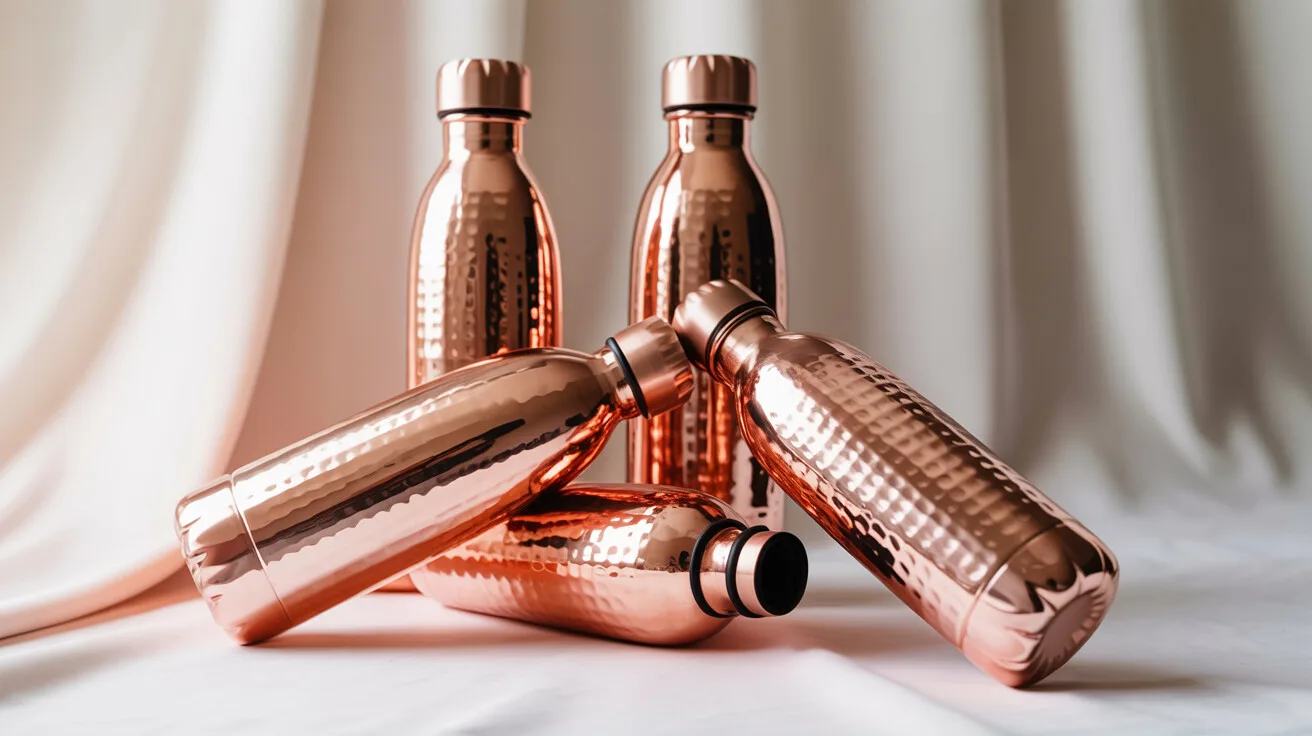
The Kosdeg is the copper water bottle you buy when you want something beautiful enough to display — and functional enough to use daily. Each bottle is hand-hammered by skilled artisans, creating unique surface variations that aren't just decorative: the hammering process work-hardens the copper, increasing durability while creating microscopic texture that increases surface area for copper ion interaction with water.
With thousands of verified purchases and consistently high customer satisfaction, Kosdeg has built a strong reputation for premium quality. The extra-thick copper walls feel substantial in your hands — this isn't a flimsy bottle that will dent if you set it down wrong. The silicone gasket in the screw-top lid ensures leak-proof storage even in bags.
The Kosdeg sits at the upper end of the Budget-Friendly tier, and for good reason: this is a product you'll use daily for potentially years. The artisan craftsmanship supports traditional metalworking communities. And frankly, it looks stunning on your desk, kitchen counter, or nightstand.
✅ Pros
- Stunning hand-hammered artisan craftsmanship
- Extra-thick copper walls — superior durability
- Thousands of satisfied customers over years
- Leak-proof silicone gasket lid
- Museum-quality aesthetics for display
- Each bottle is uniquely handcrafted
❌ Cons
- Highest-priced option in our comparison
- Hammered texture slightly harder to clean
- Heavier than smooth-finished bottles
- No carrying bag or case included
Our verdict: The Kosdeg is for those who appreciate craftsmanship and want their daily wellness routine to feel luxurious. It's the premium choice in the Budget-Friendly tier — and one you'll enjoy every time you use it.
3. Far Copper Water Bottle — Best for Active Lifestyles (Elyvora US Score: 8.7/10)
💰 Budget-Friendly
Not everyone wants their copper water bottle to be a statement piece. If you're looking for something that slips into a gym bag, fits in car cup holders, and handles the demands of an active lifestyle, the Far is your bottle.
The streamlined, minimalist design is intentional — this bottle was engineered for function over form. The joint-free construction means no weak seams that could leak when you're tossing it in your yoga mat strap or gym bag pocket. At the most affordable end of the Budget-Friendly tier, it's priced where you can own multiple bottles without guilt: one for home, one for the office, one for the gym.
The 1000ml capacity provides plenty of hydration for workouts, while the lightweight design (compared to thick-walled premium bottles) makes it practical for all-day carry. It's pure copper doing exactly what the research says it should — delivering antimicrobial benefits and trace mineral supplementation without the premium design markup.
✅ Pros
- Most affordable pure copper option in our comparison
- Lightweight for active, on-the-go use
- Joint-free leak-proof construction
- Fits standard cup holders and bags
- Simple design easy to clean
- Great for buying multiples
❌ Cons
- Basic aesthetics — not a display piece
- Thinner copper walls than premium options
- Smaller review base than established brands
- No accessories included
Our verdict: The Far delivers excellent value for active users who need practical, affordable copper hydration. Perfect for gym-goers, yoga practitioners, and anyone who prioritizes function over aesthetics.
4. CUPMER Pure Copper Water Bottle — Best Value Entry Point (Elyvora US Score: 8.5/10)
💰 Budget-Friendly
Here's what the peer-reviewed science tells us that the wellness industry doesn't want you to know: copper is copper. A pure copper bottle delivers the same oligodynamic effect and antimicrobial benefits regardless of brand. The Sudha et al. study used simple copper vessels — not premium artisan bottles. The antimicrobial mechanism works based on copper purity, not price tag.
The CUPMER enters the market with the lowest price point in our comparison while delivering genuine handcrafted pure copper. Early adopters are enthusiastic — the initial customer satisfaction rates are excellent. While the review base is still growing compared to established brands like Kitchen Science and Kosdeg, those early buyers report quality that punches well above the price point.
You get a choice of plain smooth finish or hand-hammered texture at the same price. The heavy-gauge copper construction rivals bottles at higher price points. For budget-conscious buyers, families wanting to equip everyone, or skeptics who want to try copper water without a major investment, CUPMER removes the financial barrier entirely.
✅ Pros
- Lowest price point — exceptional value for pure copper
- Outstanding early customer satisfaction
- Choice of plain or hammered finish
- Heavy-gauge copper at budget pricing
- Perfect entry point for beginners
- Affordable enough for whole family
❌ Cons
- Newer brand — still building long-term reputation
- Smaller review base than established competitors
- May sell out frequently due to demand
- No accessories or carrying case
Our verdict: The CUPMER is a smart calculated bet with excellent early indicators. At the lowest price in our comparison, the downside is minimal and the science behind pure copper doesn't care about brand names. Great for beginners or budget-conscious buyers.
🎯 Which Copper Water Bottle Should You Buy?
Now that you understand the science — the oligodynamic effect eliminates bacteria within 16 hours, the EPA registered copper as the only antimicrobial metal, and pure copper delivers the maximum benefit — the question isn't whether copper hydration works. It's which bottle matches your lifestyle:
→ "I want verified quality with practical accessories"
Get the Kitchen Science (9.3/10). Lab-tested purity plus included canvas bag delivers the best overall package.
→ "I want something beautiful I'll be proud to display"
Get the Kosdeg Hammered (9.1/10). Hand-hammered artisan craftsmanship creates a functional piece of art.
→ "I need something lightweight and gym-friendly"
Get the Far Sports (8.7/10). Streamlined design built for active lifestyles at the most accessible price.
→ "I want to try copper water without a big investment"
Get the CUPMER (8.5/10). Genuine pure copper at our lowest tested price with excellent early feedback.
How to Use Your Copper Water Bottle (Science-Backed Best Practices)
Getting the most from your copper bottle is straightforward — and the research tells us exactly why each step matters:
- Fill at night: Pour room-temperature water into your copper bottle before bed
- Let it sit 6-8 hours: This is the optimal contact time — the Sudha et al. study showed complete bacterial elimination at 16 hours, meaning 6-8 hours provides substantial antimicrobial activity while keeping copper levels safe
- Drink in the morning: Traditional practitioners recommend drinking copper water first thing, before eating — this maximizes trace mineral absorption
- Rinse after each use: Simple warm water rinse prevents buildup
- Weekly deep clean: Use a paste of lemon juice and salt, let sit 5 minutes, rinse thoroughly — this removes patina and restores surface quality
What NOT to do:
- Don't store acidic beverages (lemon water, juices, soda) — acids react with copper and can create harmful compounds
- Don't put in the dishwasher — hand wash only to preserve the copper surface
- Don't store water for more than 12 hours — 6-8 hours is the scientifically optimal window
- Don't exceed 2-3 glasses of copper water daily — moderation keeps you well within safe intake levels
❓ Frequently Asked Questions
Is drinking water from a copper bottle actually healthy?
Peer-reviewed research supports antimicrobial benefits. The Sudha et al. (2012) study showed copper vessels eliminate E. coli, Salmonella, and V. cholerae within 16 hours. Your body needs 0.9mg of copper daily — copper water contributes a safe fraction of this. However, excessive copper intake can be harmful. Stick to 2-3 glasses daily and consult your doctor if you have concerns, especially regarding Wilson's disease.
How long should water sit in copper before drinking?
6-8 hours is optimal. This gives enough time for the oligodynamic effect to work — copper ions naturally leach into the water at safe concentrations. The Sudha et al. study showed complete bacterial elimination at 16 hours, so 6-8 hours provides substantial benefit. Don't exceed 12 hours, as copper levels may become unnecessarily concentrated.
How do I clean a copper water bottle?
Rinse daily, deep clean weekly. After each use, rinse with warm water. Weekly, make a paste of salt and lemon juice (or vinegar), rub gently inside and out, let sit 5 minutes, then rinse thoroughly and dry. This removes tarnish and restores shine. Never use dishwashers — they can damage the copper surface.
Can I put lemon water in a copper bottle?
No — avoid all acidic beverages. Acids react with copper, potentially creating harmful compounds and damaging your bottle. This includes lemon water, fruit juices, coffee, tea, wine, and carbonated drinks. Use copper bottles only for plain water.
Why does my copper bottle turn green/dark?
This is natural patina — copper's normal oxidation. It's not harmful and doesn't affect water quality or antimicrobial function. Regular cleaning with lemon and salt removes patina and restores the copper's original shine. Some people actually prefer the aged patina look — it's purely an aesthetic preference.
Final Verdict: The Science Supports All Four — Your Lifestyle Picks the Winner
The peer-reviewed evidence is clear: pure copper water bottles deliver documented antimicrobial benefits through the oligodynamic effect, provide safe trace mineral supplementation, and self-sanitize through EPA-recognized contact killing. All four bottles in our comparison use pure copper — the material that 5 studies confirm is maximally effective.
The Kitchen Science (9.3/10) wins for most people — lab-tested purity gives confidence that the antimicrobial mechanism is actually working, and the included canvas bag adds genuine practical value.
The Kosdeg (9.1/10) wins for design-conscious buyers who want artisan craftsmanship they'll be proud to display daily.
The Far (8.7/10) wins for active users who need function over form at the best price-to-performance ratio.
The CUPMER (8.5/10) wins for beginners and budget-conscious buyers — because the science doesn't care about brand names.
The bottom line: the best copper water bottle is the one you'll actually fill every night and drink from every morning. Whether you choose the top-rated Kitchen Science or the value-driven CUPMER, the antimicrobial benefits documented by Sudha, Grass, Espírito Santo, Vincent, and Sharan apply equally. Pick the one that fits your lifestyle — and start enjoying science-backed copper hydration tomorrow morning.
📚 Scientific References
All claims in this article are supported by peer-reviewed research. Click any citation to verify at the source.
- Sudha VBP, et al. "Storing Drinking-water in Copper pots Kills Contaminating Diarrhoeagenic Bacteria." J Health Popul Nutr. 2012;30(1):17-21. PMID: 22524115
- Grass G, Rensing C, Solioz M. "Metallic Copper as an Antimicrobial Surface." Appl Environ Microbiol. 2011;77(5):1541-1547. PMID: 21193661
- Espírito Santo C, et al. "Bacterial Killing by Dry Metallic Copper Surfaces." Appl Environ Microbiol. 2011;77(3):794-802. PMC: PMC3028699
- Vincent M, et al. "Contact killing and antimicrobial properties of copper." J Appl Microbiol. 2018;124(5):1032-1046. PMID: 29280540
- Sharan R, et al. "Inactivation and sub-lethal injury of Escherichia coli in a copper water storage vessel: effect of inorganic and organic constituents." Antonie Van Leeuwenhoek. 2010;98(1):103-112. PMID: 20358286